Coexistence and Hybrid MDM Architecture Patterns
Last week, we stepped back and looked at the four foundational master data architecture models: registry, consolidation, coexistence, and centralized. The goal was not to rank them, but to understand what each one is designed to solve and the assumptions each model makes about ownership, control, and operational reality. On paper, these architectures are distinct and well defined. In practice, most organizations recognize pieces of themselves in more than one model.
This week, we move out of the abstract and into how those models show up over time. Coexistence and hybrid architectures rarely start as deliberate design choices. They emerge as organizations grow, systems accumulate, and ownership becomes distributed across teams. This article focuses on how coexistence actually works in production environments, why hybrid MDM becomes the default rather than the exception, and what design and governance decisions allow these architectures to remain stable as the business continues to change.
How Master Data Evolves When Organizations Grow Faster Than Their Models
Most master data conversations begin with architecture.
Teams review diagrams, compare styles, and debate tradeoffs. Registry feels lightweight. Consolidation feels safe. Centralization feels controlled. Coexistence feels powerful but complex. On paper, each model appears to be a deliberate choice, almost like selecting a framework at the start of a software project.
That framing breaks down quickly in real environments.
By the time most organizations start talking seriously about master data, they already have systems in production that matter deeply to the business. Those systems process revenue, payroll, regulatory reporting, customer communication, and operational workflows. They have owners, support models, and political gravity. Replacing or sidelining them is rarely realistic, even when the data inside them is fragmented or inconsistent.
This is the environment where coexistence MDM architecture and hybrid MDM architecture patterns emerge. Not because teams lack discipline, but because the organization has already made years of decisions before master data became a priority.
Understanding coexistence requires understanding that history.
Why Coexistence MDM Architecture Exists at All
Coexistence MDM starts with a basic observation that is easy to overlook when designing from scratch. No single system owns master data end to end in a mature organization.
Customer data provides a familiar example. Sales teams manage customer identities and relationships in CRM systems. Finance teams manage billing details and payment terms in ERP platforms. Compliance teams apply classifications and restrictions in systems designed for regulatory oversight. Digital teams manage preferences and communication settings through portals and customer-facing applications.
Each system is authoritative for something. None of them is authoritative for everything.
Early MDM efforts often try to resolve this by declaring one system the system of record for the entire entity. That approach can work in smaller or younger environments. In larger organizations, it usually creates friction. Teams resist losing control over data they are accountable for. Processes break when updates are forced through unfamiliar tools. Workarounds appear almost immediately.
Coexistence emerges as a response to that friction.
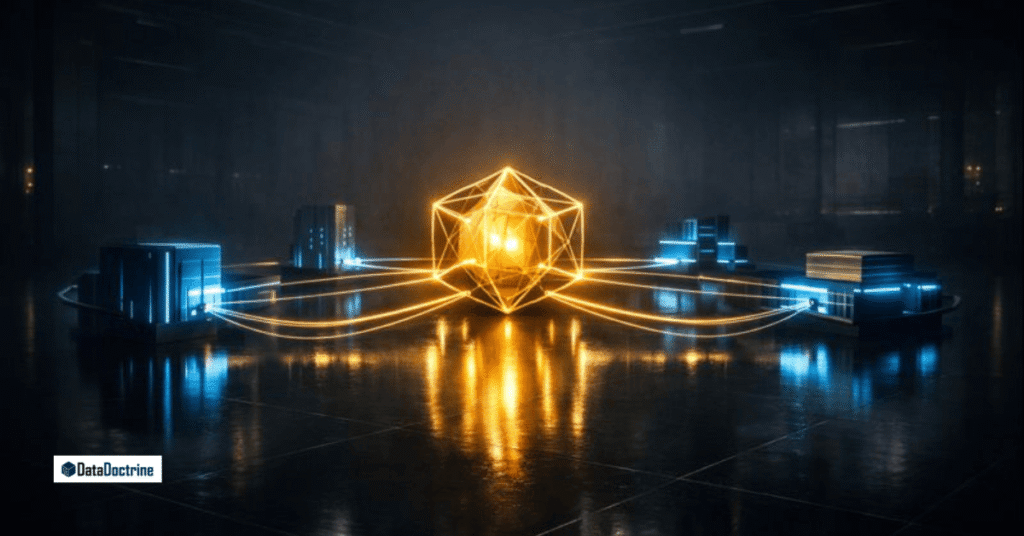
In a coexistence MDM model, a central hub maintains the mastered record, but source systems are still allowed to contribute updates. The hub does not replace operational systems. It coordinates them. Updates flow from source systems into the hub, where they are validated, reconciled, versioned, and then synchronized back out to other systems that depend on that data.
The hub acts less like a command center and more like a referee. It enforces rules rather than asserting ownership.
How Coexistence MDM Architecture Shows Up in Practice
Coexistence is rarely implemented as a single, decisive architecture shift. It tends to appear gradually, often without being labeled as such.
An organization might begin by integrating customer data from multiple systems into a central repository for reporting. Over time, data quality rules are added. Matching logic improves. Duplicate resolution becomes more reliable. Eventually, downstream systems begin to trust the mastered view more than their local copies.
At some point, a business team asks a reasonable question. If the hub has the cleanest version of the data, why can it not send updates back?
That question marks the transition from consolidation MDM to coexistence MDM.
In day-to-day operations, coexistence often appears unremarkable. Sales teams continue updating customer names and contact details in CRM. Finance continues updating billing addresses and payment terms in ERP. Compliance teams update regulatory flags in their own systems. The difference is that each of those changes is now governed by attribute-level trust rules enforced centrally.
Only certain attributes are allowed to flow from each system. Updates are validated before they are accepted. Conflicts are resolved according to predefined MDM survivorship rules rather than timing or convenience. Changes are tracked so that history can be explained later.
From the user’s perspective, very little changes. From an architectural perspective, everything changes.
Why Organizations Choose the Coexistence MDM Model
Organizations do not choose coexistence because it is elegant. They choose it because it fits how work already happens.
One reason is operational continuity. Forcing users to abandon familiar systems in favor of a centralized interface often introduces more risk than value. Coexistence allows teams to continue working where they are most effective, while still improving data consistency across the enterprise.
Another reason is risk management. Coexistence supports incremental adoption. A program can start with a small subset of attributes or a single domain and expand over time. This makes failures visible early, when they are easier to correct, and prevents large scale disruptions.
Coexistence also supports both operational and analytical needs without forcing artificial separation. Real time master data synchronization keeps operational systems aligned, while the mastered view supports reporting, analytics, and downstream integrations.
Perhaps most importantly, coexistence aligns with federated organizations. Many enterprises operate with distributed ownership by design. Business units are accountable for their data and processes. Coexistence respects that accountability while still imposing enterprise level consistency.
Why Coexistence MDM Architecture So Often Struggles
Despite these advantages, coexistence has a reputation for being fragile. That reputation is not undeserved.
One common failure point is unclear ownership. Many teams stop defining ownership at the entity level. They declare that a system owns Customer or Product without addressing the fact that those entities represent multiple concerns. Without clear attribute level ownership, conflicts are inevitable. Systems overwrite each other. Data stewards are left mediating disputes instead of enforcing rules.
Another failure point is conflict resolution. In the absence of explicit survivorship rules, many implementations default to last write wins. That approach feels simple, but it hides data loss and creates unpredictable outcomes. Over time, teams stop trusting the mastered record because they cannot explain why values change.
Latency introduces quieter problems. If synchronization delays cause users to see outdated data in downstream systems, they compensate locally. They edit data where they can see it change immediately. Those local fixes drift away from the mastered view, undermining the entire coexistence MDM architecture.
Customization also accumulates. Each exception adds logic. Each special case introduces coupling. Over time, the hub becomes harder to change than the systems it was meant to simplify.
These failures are rarely caused by technology choices. They are caused by governance decisions that were deferred or avoided.
What Makes a Coexistence MDM Architecture Stable Over Time
Stable coexistence implementations share a set of design habits rather than a specific architecture.
They begin with domain clarity. Entities are decomposed into domains that reflect how the business actually uses the data. Identity, billing, compliance, and preferences are treated as separate concerns, even when they roll up into a single master record.
They apply trust at the attribute level. Systems are not trusted wholesale. Specific attributes are. Rules define who can update what, under which conditions, and with what approvals.
They treat the hub as an active control point rather than a passive router. Validation happens centrally. Changes are versioned. Lineage is preserved. When a value changes, there is a clear explanation available later.
They establish stewardship and governance early. Data ownership is not theoretical. It is operational. Business stakeholders participate in defining rules and resolving conflicts, rather than being informed after the fact.
These practices do not eliminate complexity. They make it manageable.
Why Hybrid MDM Architecture Becomes the Natural Outcome
Very few organizations apply a single MDM style consistently across all data domains.
Hybrid MDM architectures emerge because different types of master data behave differently.
Product data often has fewer owners, clearer lifecycles, and stricter controls. Centralized MDM architecture works well in those cases.
Customer data spans sales, finance, service, compliance, and marketing. Coexistence aligns better with that reality.
Reference data may only require consolidation. Identity resolution may only require registry capabilities.
Hybrid MDM is not a sign of indecision. It is a reflection of uneven maturity across domains.
How Organizations Evolve Across MDM Architecture Patterns Without Breaking Trust
Successful MDM programs rarely begin with coexistence.
They begin by identifying records across systems using registry-style patterns. They move toward consolidation to gain visibility and improve quality. Only later do they allow updates to flow in multiple directions.
This staged evolution across MDM architecture patterns reduces risk and builds trust. It also exposes governance gaps early, when they are still manageable.
Some domains may never progress beyond consolidation. Others may eventually centralize. That unevenness is normal and should be expected.
The goal is not to reach a final architecture. The goal is to remain stable while the organization continues to change.
When Coexistence MDM Is the Wrong Fit
Coexistence is not always appropriate.
If governance authority does not exist, coexistence amplifies disorder. If latency cannot be tolerated, centralized MDM architecture may be safer. If systems cannot integrate reliably, consolidation may be the practical ceiling.
Recognizing those limits is part of responsible design.
A Final Perspective
Coexistence and hybrid MDM architectures exist because organizations grow faster than their models.
They work when ownership is clear, rules are enforced, and evolution is intentional. They fail when governance is deferred and complexity is ignored.
The most important decision is not which MDM style to adopt. It is whether the architecture reflects how the organization actually operates today and whether it can adapt as that reality changes.
That is how master data becomes something the business can live with, trust, and sustain over time.
FAQ
1. What is coexistence MDM?
Coexistence MDM is an architecture where a central hub maintains the mastered record, but multiple operational systems are allowed to update it. Each system remains authoritative for specific attributes rather than the entire entity. The hub validates changes, applies rules, tracks history, and synchronizes updates across systems. Coexistence exists to align systems that already own different parts of the truth without forcing them into a single operational platform.
2. How is coexistence different from consolidation MDM?
Consolidation MDM pulls data from source systems into a central location to create a unified view, usually for reporting or analytics. Updates typically flow in one direction, from source systems into the hub. Coexistence goes further by allowing updates to flow both ways. In a coexistence model, operational systems can contribute changes that are governed, merged, and then redistributed. Consolidation focuses on visibility. Coexistence focuses on coordination.
3. What causes coexistence MDM to fail?
Coexistence MDM fails most often due to governance gaps rather than technical limitations. Common causes include unclear ownership at the attribute level, weak conflict resolution rules, reliance on last write wins logic, and unmanaged synchronization delays. Over time, excessive customization and exceptions can also make the architecture fragile. When teams cannot explain why data changed or who was allowed to change it, trust erodes and the model breaks down.
4. What is a hybrid MDM architecture?
A hybrid MDM architecture uses different MDM styles for different data domains. An organization might centralize product data, use coexistence for customer data, and rely on consolidation or registry patterns for reference or identity data. Hybrid architectures emerge naturally because domains differ in ownership, risk, and operational needs. Hybrid MDM is not a temporary state. It is how most mature organizations operate.
When should you centralize a master data domain?
Centralization makes sense when a domain has clear ownership, limited contributors, strict controls, and low tolerance for inconsistency. Product data, pricing structures, or regulated reference data often meet these conditions. Centralization is also appropriate when latency must be minimal or when operational systems cannot reliably synchronize changes. Choosing centralization for a specific domain is not a failure of coexistence. It is a recognition of practical constraints.