In last week’s article, Versioning and Lineage in Master Data, we talked about the importance of versioning and lineage in master data. We covered how storing only the current state of a record erases vital context, breaks audit trails, and causes reporting drift. Without a clear view of how data evolved, teams can’t explain what changed, why it changed, or when those changes occurred.
This week, we’re focusing on another piece of the trust puzzle: why you can’t blindly rely on source systems. Just because a system created the data doesn’t mean it’s accurate, consistent, or complete across all use cases. In this post, we’ll break down why origin alone isn’t enough and how to build a framework that makes trust a process, not a guess.
What a Source System Really Is
A source system is the place where a piece of data is first created. It’s where data originates. Your CRM creates leads and contact details. Your ERP creates vendors and billing profiles. Your HRIS creates employee records. These systems play important roles.
But origin isn’t enough. Just because a system creates a record doesn’t mean that record is accurate, complete, or ready for use across the business. It means the system did its job…not that it did everyone else’s.
Defining Source System vs System of Record
The source system is where data starts. The system of record is where your organization chooses to treat that data as the truth for a specific purpose. Sometimes they’re the same. Often they’re not.
Why Origin Alone Doesn’t Guarantee Accuracy
Source systems only collect what they need to function. That might not be what analytics teams, compliance officers, or downstream integrations require. The CRM doesn’t care about tax IDs. The ERP might not validate phone formatting. The support system might abbreviate company names inconsistently. You get functional data, but not enterprise data.
Where Source Systems Fall Short in Master Data
Different Purposes Lead to Different Business Rules
Each system defines data based on its own needs:
- In CRM: A customer might be any closed opportunity.
- In ERP: A customer might require tax, billing, and legal validation.
- In analytics: A customer might be anyone with at least one paid invoice.
They all describe the same entity, but with different rules. There is no single, shared definition.
Incomplete or Inconsistent Field Values
Gaps are common. Source systems often skip fields that aren’t critical to their workflows:
- CRM users leave TaxID blank or enter placeholders.
- ERP users leave contact names null because they don’t drive billing.
- HR tools log job titles without maintaining alignment to the org chart.
These gaps break joins, block reports, and frustrate business teams.
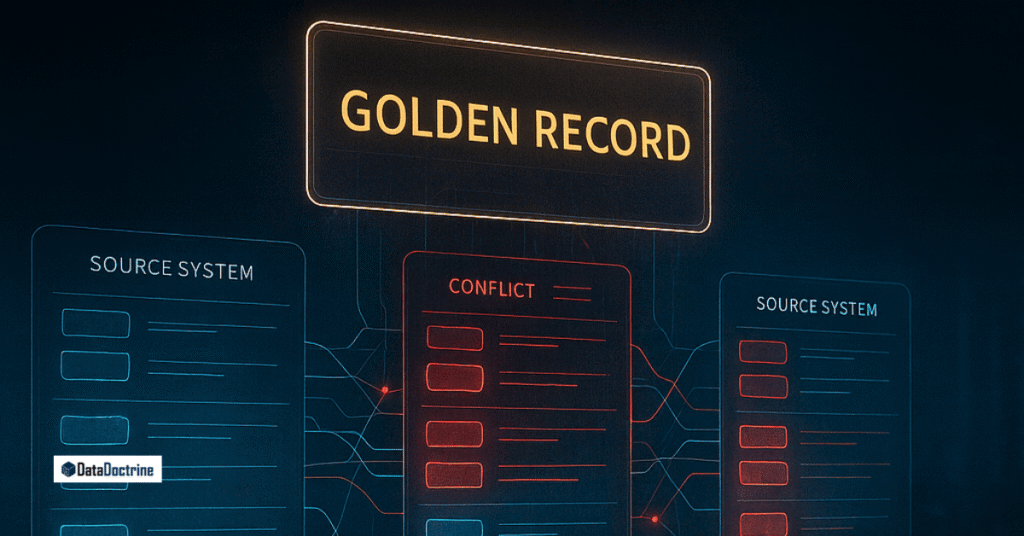
Conflicting Records Across Multiple Systems
Here’s what you might find:
| System | Name | Address | Phone |
|---|---|---|---|
| CRM | Northbeam Corp | 819 Third St | 555-2768 |
| ERP | NORTHBEAM CORPORATION | 819 Third St, Suite A | 555-2768 x200 |
| Support | Northbeam Co. | 819 Third St | (555) 2768 |
None are wrong. But none are reliable across every use case either.
Why Conflict Resolution Is Essential in MDM
When Selecting a Single Source Doesn’t Work
Choosing one system as the “truth” creates blind spots. The CRM might be best for contact details, but unreliable for billing. ERP might have financials right but botch company names.
Blending, Standardizing, and Preserving Data Fidelity
Master data requires nuance:
- Use field-level priorities: CRM for contact, ERP for billing.
- Blend values when needed: Combine address lines.
- Standardize for consistency: Normalize casing, punctuation, and formats.
The goal isn’t to crown a single source. It’s to produce trusted data across contexts.
How to Build a Master Data Trust Framework
Field-Level Source Ranking
Assign priority by field, not entity. One system may be more reliable for address, another for phone, another for classification. Store these rules and apply them consistently.
Confidence Scoring for Completeness and Recency
Automate scoring based on:
- Presence of key attributes
- Recency of updates
- Match to known reference lists
Confidence scores help resolve ties when multiple systems provide overlapping values.
Business Rules for Context-Driven Decisions
Examples:
- If CustomerType = “Enterprise,” use ERP for billing address.
- If Region = “Europe,” prefer Salesforce over legacy CRM.
These rules align master data decisions with actual business operations.
Manual Overrides for Stewardship
Sometimes automation isn’t enough. You need:
- Exception handling tools
- Approval workflows
- Audit trails
Stewards need clear authority to override, fix, or escalate edge cases.
Trust vs Truth in Master Data Management
Fit-for-Purpose Contexts: Billing, Reporting, and Analytics
A billing system needs legal names and tax details.
A marketing platform needs clean contact fields.
A supply chain model needs accurate site and SKU mappings.
Truth depends on the lens.
Why a Universal Source of Truth Doesn’t Exist
There is no single truth.
There is only context: what is true for this purpose, right now.
Your job is not to debate which source is most truthful.
Your job is to produce the version that drives the right outcomes.
Best Practices for Managing Source System Data
Treat Sources as Inputs, Not Gospel
Use source systems as contributors, not rulers. No single system gets the final say without checks.
Document and Enforce Trust Policies
Write down your trust framework:
- Field-level priorities
- Rule logic
- Steward escalation paths
This creates visibility, consistency, and accountability.
Monitor Trends in Conflicts and Overrides
Log every time two sources conflict. Track overrides. Use that data to:
- Improve upstream systems
- Refine trust rules
- Reduce downstream work
Reassess Rankings as Systems Evolve
Just because ERP was right last year doesn’t mean it is now. Reevaluate source rankings quarterly or when processes change.
Final Thought: Trust the Framework, Not the Source
Data rarely stays clean on its own. Systems evolve. Processes drift. People enter values in ways no one planned for. Over time, even well‑designed data begins to pull itself apart. That’s why MDM exists. Its job is to reconcile those differences and bring order back to the mess that naturally forms. So don’t trust a system just because it was first, and don’t chase a single, universal truth. Build a framework you believe in, and apply it the same way every time.