MDM Is Not a Tool – It’s a Practice Built on Process and Governance
In last week’s post, The Myth of the Golden Record in Master Data Management, we explored why the “single source of truth” often breaks down in real-world MDM, and why purpose-built views are a better path forward.
This week, we’re shifting focus from outcomes to approach. Buying a shiny new tool won’t fix broken processes or weak governance. We’ll break down why technology alone can’t deliver trusted data, and what it really takes to build a sustainable MDM capability.
Buying an MDM Platform Doesn’t Mean You’re Doing Master Data Management
Investing in a Master Data Management (MDM) platform is a smart move, but it’s only one step toward a functioning MDM program.
You can sign a multi-year contract, stand up the infrastructure, integrate a few systems, and still have no effective MDM capability.
It happens more than most teams admit. Months after go-live, leaders are frustrated, data stewards are firefighting duplicates, and no one is sure:
- Who owns which data domain
- How the golden record is built
- Which survivorship rules to trust
Core truth: A tool can’t replace the discipline of MDM. Without process, governance, and culture, you’re left with expensive software sitting on top of the same messy, inconsistent data.
A Tool Supports the Practice – It Doesn’t Replace It
What an MDM Tool Can Do
- Match and merge duplicate records
- Track lineage and attribute history
- Enforce survivorship logic
- Define hierarchies and rollups
- Integrate core entities across systems
What It Can’t Do
- Define ownership of customer master data or product master data
- Resolve conflicts between CRM, ERP, and other sources
- Establish what “complete” means for a vendor profile
- Align product categories across business units
- Decide which source system wins during a merge
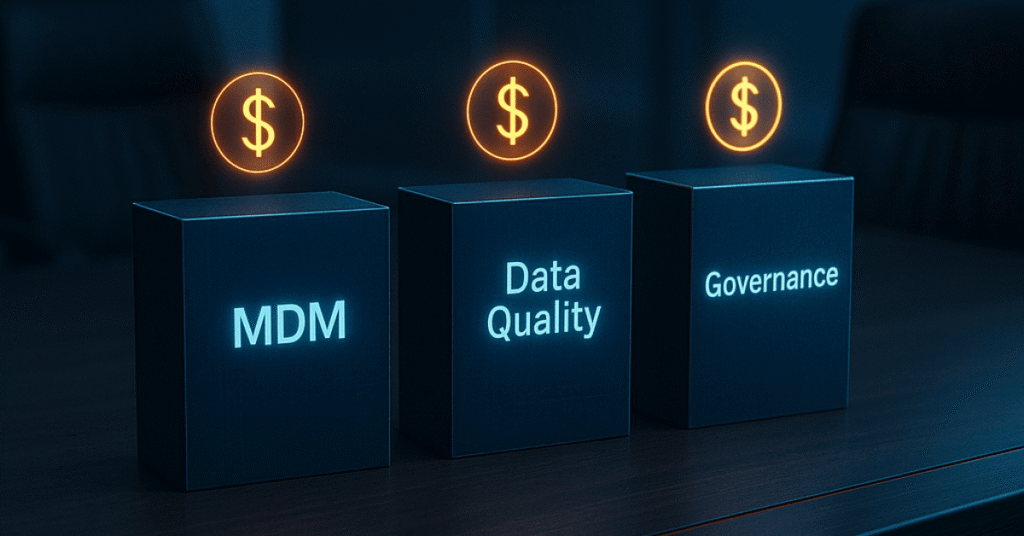
The 3 Foundations of a Successful MDM Practice
1. Process
The master data lifecycle needs clearly defined rules for:
- Record creation and updates
- Role-based change permissions
- Validation and approval checkpoints
- Sharing data with other systems
Processes must reflect actual business operations. If local teams create product records but central teams validate them, your workflow must mirror that reality. Without it, your MDM tool becomes a free-for-all.
2. Governance
Governance defines what the tool enforces. This includes:
- Data domains (customer, product, location, vendor)
- Stewardship roles and responsibilities
- Quality rules with thresholds and escalation paths
- Policies for versioning and auditing
- Conflict resolution procedures
Without governance, an MDM tool simply automates upstream chaos.
3. Culture
Culture drives adoption. Executive buy-in ensures that data producers, business users, and leaders all understand that consistent master data is a competitive advantage.
Clean, governed data powers:
- Accurate reporting
- Better customer experiences
- Regulatory compliance
- Operational efficiency
What Top MDM Teams Do Differently
High-performing MDM programs treat it as a business capability first, and a technology solution second. They:
- Start with a real business problem, not a technical wish list
- Assign ownership for each data domain before building integrations
- Write survivorship and validation rules in plain business language
- Build for adoption with dashboards, training, and feedback loops
- Document every decision for future teams
- Design flexible models that adapt with the business
The Hidden Risk of Treating MDM as “Just a Tool”
When MDM is seen as “IT’s system,” governance becomes little more than user permissions. Business stakeholders disengage, ownership disputes emerge, and integrations start propagating bad data. Common results include:
- Brittle or incomplete data
- Political disputes over definitions
- Projects stalling due to unclear requirements
- Errors spreading downstream
Final Thought: You Can’t Buy Your Way Into Trusted Data
A powerful MDM platform without process and governance will fail to deliver.
If you’re serious about improving master data quality, treat MDM as a discipline that lives inside the business. The tool is there to enforce the rules, but you must define those rules first.